

Skip to content
01Guide · Dry Rot
01 / 04
Guides · Damp & Timber

What does dry rot look like?

Dry rot is a fungus that eats structural timber. It starts as fine grey strands, turns wood brown and cracked into cubes, and ends in a rust-coloured fruiting body. Here is what each stage looks like, and what actually fixes it.

↳ 02 The guide
02Article · The Long Read
02 / 04

The brief

Last reviewed · 13 August 2026

Dry rot is the most serious form of fungal decay you can find in a building. Left alone it will spread through timber and travel across masonry to reach more of it. The good news is that it cannot survive without water: every outbreak starts with a leak, and every proper repair starts with finding it. This guide shows you what to look for, in the order you are likely to see it.

20%Timber moisture needed
Serpulalacrymans, the fungus
CuboidalCracking pattern
SpreadsThrough masonry too
CHAPTER01

The smell, before you see anything

A damp, mushroomy smell in a room with no obvious cause is worth taking seriously. It is not proof of anything on its own, but it is often the first sign, and it tends to be strongest near the floor: under stairs, in a cellar, along a skirting on an outside wall.

If you can smell it and you cannot see it, something wet is hidden. That is the point to look properly rather than to redecorate.
CHAPTER02

Fine grey strands, like cobwebs

Early growth shows as fine strands spreading across timber and onto plaster. The Property Care Association describes it as "fine grey strands develop, similar to cobwebs, which enables the dry rot to spread from the infected timber onto the surface of the wall."

This is the stage most people paint over. It is also the cheapest stage to deal with.

CHAPTER03

Cotton-wool growth, and water droplets

In still, humid conditions the fungus produces what the PCA calls "a mass of cotton wool-like growth with bright lemon-yellow patches." Water droplets form on its surface. That is where the name comes from: lacrymans is Latin for tears.

In drier spots the same growth appears instead as a thin silken grey skin, sometimes with a lilac tinge. Same fungus, different conditions.

CHAPTER04

Brown timber that cracks into cubes

This is the sign most people picture, and the one worth memorising. As the fungus feeds, the wood darkens and splits into a grid of squares, across the grain and along it. The PCA calls it "the characteristic cuboidal cracked appearance." Eventually the timber crumbles to a dry brown powder.

The catch: timber can lose real strength while still looking intact, because the fungus takes the sugars out of the cellulose before the structure of the wood visibly gives way. Prod suspect timber with something sharp. If the point sinks in, the wood is gone whatever it looks like.

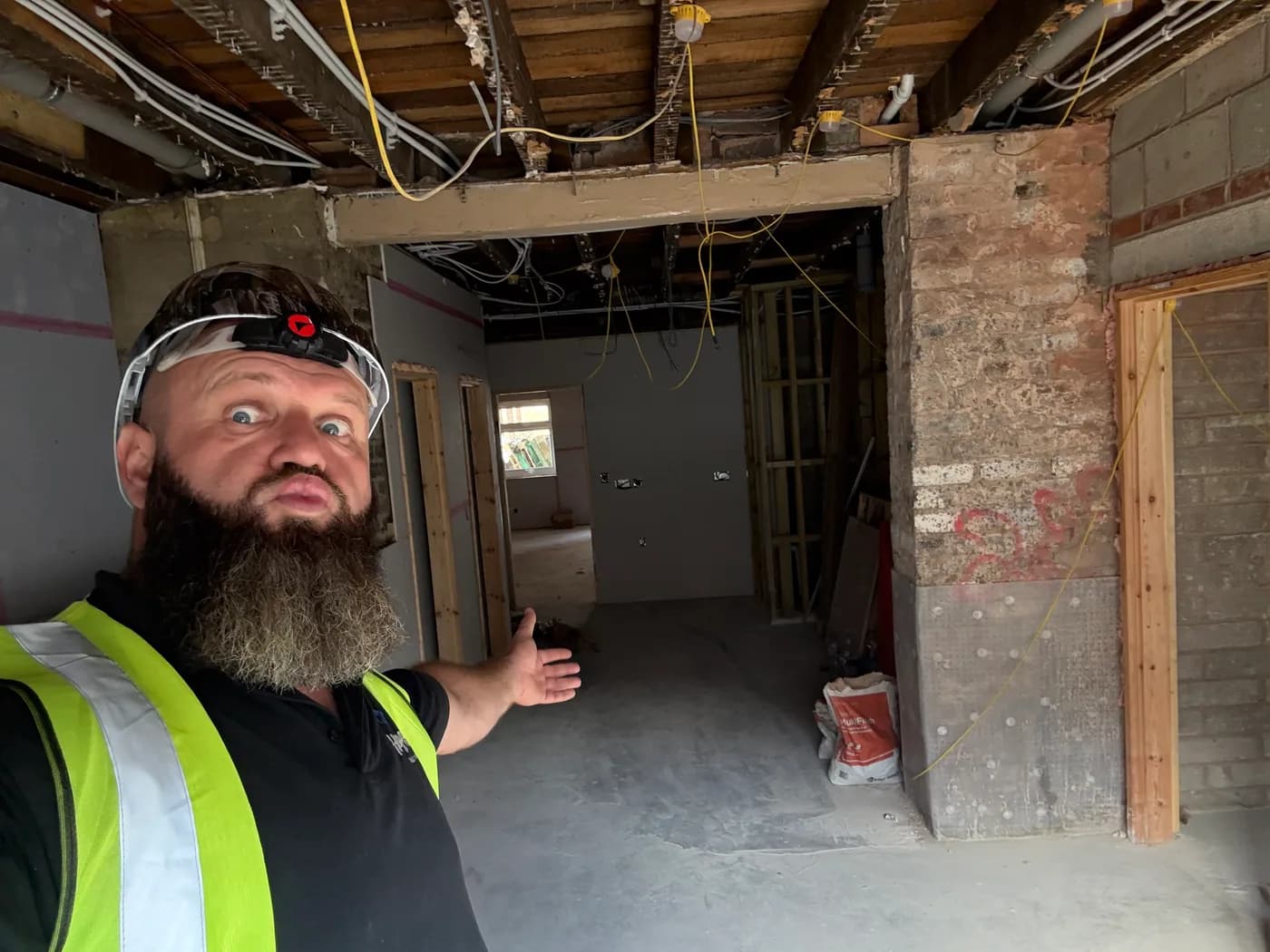
Structural floor and ceiling timbers exposed during a HYPE strip-out, with plasterboard and finishes removed.
Opening up is how the real extent gets found. Decay hides in the timbers you cannot see from the room.
CHAPTER05

Orange dust, then a fruiting body

Patches of fine brown or orange dust are spores. Where you find them, look for what produced them: a fruiting body, usually pancake or bracket shaped, rust-red in the middle with a paler edge.

A fruiting body means the fungus has run out of easy food and is trying to spread elsewhere. By this point the damage behind it is normally well beyond what is on show.

CHAPTER06

Dry rot or wet rot?

Both are caused by the same thing: timber that is wet. The PCA's distinction is spread. Wet rot decay "is usually limited to the areas that are regularly wet," while dry rot "can spread relatively quickly in the right conditions and can even grow over masonry in order to colonise susceptible wood that may be close by."

That matters because the two need different treatment, and treating dry rot as though it were wet rot is, in the PCA's words, "less certain of success." If you are not sure which you have, get someone in who does this for a living.

CHAPTER07

What actually fixes it

Find the water and stop it. Everything else is secondary. The PCA is blunt about it: "Fungal decay always arises because the wood has become wet, in excess of 20% moisture content. Finding the source of dampness and eliminating the ingress of moisture, whilst promoting drying, is always necessary."

So the sequence on a real job is: track the leak, fix it, open up enough of the building to see how far the fungus has gone, cut out and replace what has failed, isolate sound timber from damp walls, and get air moving through the space. Chemical treatment has its place as a control measure. It is not the cure, and the same guidance warns that preservatives "should not be relied upon to provide long term protection against dry rot in conditions where timbers are persistently wet."

Anyone who quotes you for a spray and nothing else has not found your leak.

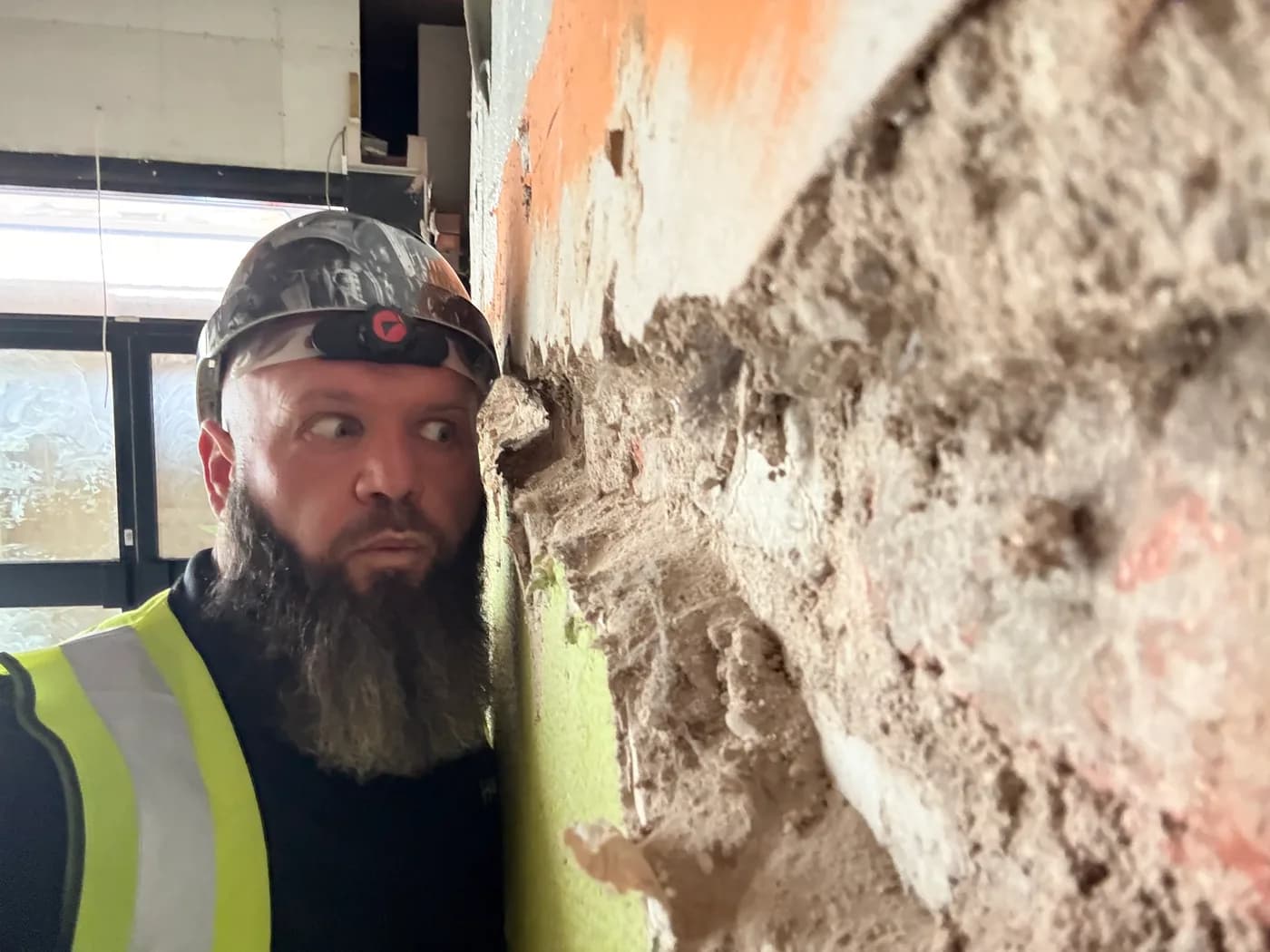
Plaster hacked back to bare brickwork on a HYPE job, exposing the wall behind the finish.
Plaster off, wall exposed. You cannot price a repair around a fungus you have not traced.
CHAPTER08

What it costs you to ignore

Dry rot is not a decorating problem. It attacks joists, wall plates, lintels, floors and roof timbers, and it moves through the wall to find fresh wood. The cost curve is steep and it runs one way: a leak you fix this month is a plumbing bill, and the same leak in three years is a structural one.

If you are buying, this is one to settle before you exchange, not after.

Found this on a property you own or manage?

We do the work.

Homes, rental property and commercial premises: priced properly, run by one project manager, and logged and photographed on The HYPE System.

↳ 03 On camera
03Guide · On Camera
03 / 04

On camera

Watch it on a real job.

John walks a property where dry rot got a hold, and shows what it does to the timber it feeds on.

↳ 04 Start your build
12Tell me about your build · Resonance
12 / 12

For the right build only

Build it right.
Build it HYPE.

We take on substantial building work across Stoke-on-Trent and the Midlands: extensions, conversions, full refurbishments, commercial works and repairs after fire, flood or damage. Properly scoped projects, not odd jobs or reactive maintenance.

We're VAT registered, so on smaller jobs a non-VAT builder will always undercut us. That's just the maths. Our work pays off where doing it properly matters more than the cheapest quote.

If that sounds like your project, tell us what you've got. We'll tell you straight whether we're right for it, and if we're not, we'll say so. Either way, we wish you all the best x.

↳ Speak to the team+44 1782 930 043Mon–Fri · 9am–5pm · Sat–Sun · Closed
End of drawing set